
.png&w=3840&q=75&dpl=dpl_5xPD23i2whwajpKcbmQZ3TCZh6dK)
Blogs/Desert Sound
Planning a Private Home Cinema in Karachi
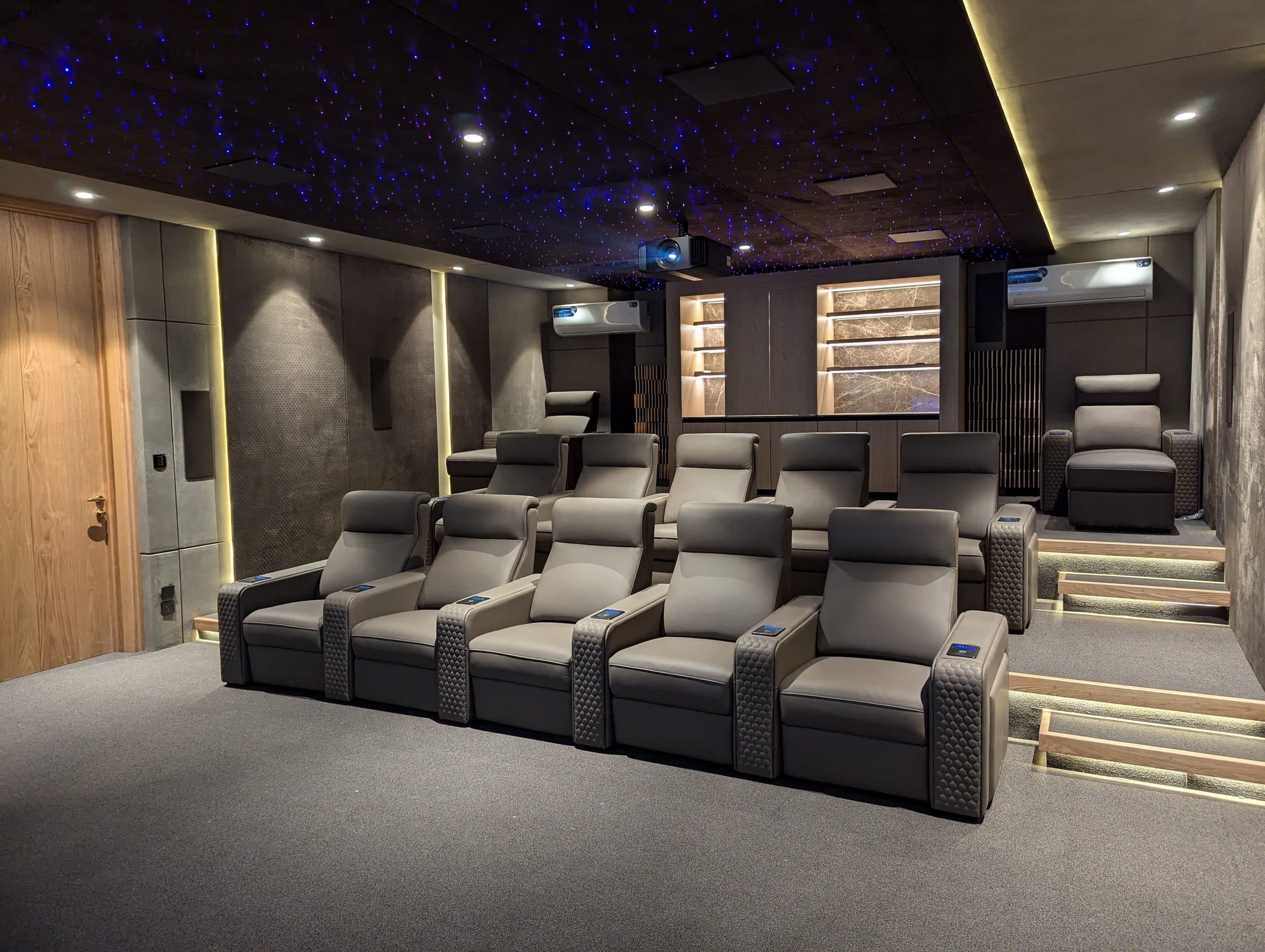
A private cinema in Karachi, in this guide, means a room in your own home, not a screening you book for an evening. It takes one of two forms: a dedicated room used only for films, or a shared lounge that turns into a cinema when the lights go down. Both need the same planning for seats, picture, sound and cables. This page walks through those choices so you know what to decide before anyone starts work.
Dedicated room or shared lounge?
The dedicated room
A dedicated room exists for watching. Walls and ceiling are dark and treated, light is fully controlled, and seats face one way. Rows of recliners on steps keep every head clear of the screen. Emerald, a dedicated room in Karachi, pairs stepped recliners with acoustic wall panels and a controlled ceiling.
The shared lounge
A shared lounge does two jobs. It plays films well, then goes back to being a family room for sport, games and guests. Furniture usually mixes recliners with a sofa, and the treatment is built into finishes rather than showing as panels. Residency, a Karachi lounge, uses recliners, a sofa, a large-format screen and acoustic wall finishes. If you are weighing the two routes, our article on choosing a media room over a dedicated home cinema goes deeper.
How to choose
Start with the week, not the photos. Ask who watches, how often, and what else happens in the room. If daylight is hard to block or the space has to host other activities, a shared lounge is often the honest answer. If films are a regular event and the room can stay dark, a dedicated layout pays off.
Planning the room
Seating and sightlines
Count viewers first, then decide on one row or two. A second row normally sits on a riser so the people behind see over those in front. Leave walking space behind and beside the seats so nobody steps over legs mid-film. Platinum, in Karachi, has two recliner rows with a bar wall at the back, so circulation was drawn in at the start.
Screen or projector
A large flat screen stays bright when lights are up, which suits a lounge. A projector gives a bigger picture and suits a room you can darken. It can hang from the ceiling or hide in a niche. Screen width follows seating distance, so fix the seats before choosing the size.
Sound and acoustics
Speakers can be built into walls and ceiling or stand beside the screen. Either way, the room itself shapes what you hear. Hard walls and bare floors make dialogue blur and bass boom. Absorbing and diffusing surfaces calm the echo so voices stay clear at lower volume.
Lighting and control
Lighting should dim in steps rather than switch off. Cove strips, wall washers and an optional star ceiling give enough light to move around without washing out the picture. One control for lights, picture and sound keeps the room simple for the whole family.
Hidden wiring
Cables are the detail most often left too late. Routes for speaker, signal and power lines need to be agreed before plaster, paint and wood panelling close the walls. Planning them early is what keeps the finished room clean, with no trunking along skirting boards and nothing hanging from the projector.
Karachi homes: what to think about
Apartments and bungalows
A private cinema works in both Karachi apartments and bungalows; the survey plans around the space you have. In an apartment, shared walls, slab ceilings and building rules shape bass levels, drilling and cable paths. In a bungalow, the distance from equipment to room and existing finished floors shape the layout. Each gets planned around its own limits.
Power and backup
Load-shedding is part of life here, so decide early which equipment should stay on through a cut and where any backup can sit with airflow. Settle that with your electrician before the walls close.
How a private cinema gets built
Every room follows the same order. First a survey measures the space, light, wiring routes and how you use it. Then the design fixes seats, screen, speakers and treatment on paper. Next comes the build, with cables hidden as walls and ceiling are finished. Last, picture and sound are calibrated to the seats rather than left on factory settings. Our home theatre design and installation page covers that service, and our guide for anyone looking for a home cinema installer in Karachi explains what to ask before you hire. The survey sets the timeline for your room.
Book a site survey
Tell us about your room and how you watch, and we will plan a private cinema around it. Book a site survey.
Frequently asked questions
Is this the same as booking a private cinema in Karachi?
No. Booking a venue gets you a screening room for one evening. This guide is about building your own private cinema at home, either a dedicated room or a shared lounge, with seats, picture, sound and hidden cables planned around how your family actually watches films, sport and games.
Do I need a dedicated room for a private cinema?
Not always. A dedicated room gives the most control over light and echo, with stepped recliners and treated walls. A shared lounge can still feel like a cinema, using recliners, a sofa, a large screen and acoustic finishes, then return to everyday family use when the film ends.
Can a private cinema work in a Karachi apartment?
Yes. A private cinema works in both Karachi apartments and bungalows; the survey plans around the space you have. In an apartment, that means fitting screen size, seating distance and speaker positions to the room, and keeping bass and cable routes within the building's rules.
How long does it take to plan and build?
The survey sets the timeline, because every room is different. What stays the same is the order: survey, design, build with cables hidden, then calibrate picture and sound to the seats. Changes to walls, ceiling or risers affect the scope, and the survey shows which apply to your room.
Contact
Ready to plan the room?
+92 21 111 570 111 · info@desertsound.com.pk
22-C/II, 2nd Zamzama Commercial Lane, Phase V, DHA Karachi
Get in touch